Check out this immensely entertaining and quite efficient
Michelin microsite by agency
Campbell-Ewald. Not only did they create a visually stunning user experience, but the message couldn't come across more clearly:
Michelin is a world (brand) that covers the entire driving experience. From making tires to getting you from point A to point B safely, maintaining clean environment standards or helping you explore the road - Michelin is all about that.
For once I'm glad to see an experiential website that's easy to navigate, and doesn't flood me with useless gizmos. Micheline World manages to be entertaining, while keeping focus on
pertinent and interesting corporate communication to the consumer. Nice job.
(Thanks, Adverblog!)
Click here to access the site.
|


Friday, October 06, 2006 by
David Claude
, under
adkrispies,
ads,
advertising,
ing,
site,
viral marketing,
web,
word of mouth,
world wide web

I usually like the TV commercials that ING's agency produces (while I couldn't get a hold of their name) - I think they're always very pertinent, believable, and well executed. Actually, I think most of ING's communication is a lot more pertinent and inviting than most banks (in Canada anyways), and I still don't understand why banks haven't thought of a way to competition such a consumer-worthy system.
Much has to be said in the same way, about their viral site, MoveOutMoveUp. The site's main proposition is to present "buying your first home" as something that's possible, and accessible.
Wow. Something that actually. Concerns. The consumer. No time wasted on trying to con the consumer with "Ooo, ahh, we have a human approach to banking" people pictorials this time.
Just one. Simple. Reality. "Paying rent isn't just getting old, it's getting expensive". Hello. Now THAT speaks to me, mr. early-thirties-guy-with-not-enough-savings-or-balls-for-a-decent-down-payment yet. But as always, ING uses its authentic, bullshitless communication strategy to convince me that there's a solution for that. And this solution is displayed inside an entertaining and clear experience. Now that is effective advertising, plain and simple.
I'll stop gabbing now, but promise you'll check out the ING site. It's worth the trip (Thanks, Ihaveanidea!)
|

The Dreamer is a website revue of the coolest things the web has to offer these days in terms of branded content, music/entertainment, photography, corporate stuff and more. It's divided into categories for your comfortable use, and you can discover a lot of interesting stuff in there.
Just like I did for the following article, right above this one. Yay! Easy references.
|
Monday, September 25, 2006 by
David Claude
, under
adkrispies,
commercials,
communication,
editorial,
poll,
tv,
viral marketing,
web,
wom,
word of mouth,
world wide web
There is a running debate in the ad industry (agencies and announcers alike) on whether ad agencies should allow the posting of ads that were initially made for TV only, on Internet sites. For example, yours truly, AdKrispies: I'm often posting TV ads of various announcers for your enjoyment, as (among other blogs of my type) I know the general public and agencies alike appreciate the artistic and communicational intelligences of these ads, and thus appreciate them being shared publicly.
But as I'm doing this, the following also happens:
- I become a new media channel for these ads. Let's say I'm displaying a recently-produced TV ad for a fictive company, Moca-Cola, then Moca-Cola gets some free advertising on a media channel they didn't pay for.
- This causes many media placement obligations to be infringed, among others this one: the agencies usually negociate actors appearing in ads depending on complex calculations, but basically withstanding reach (how many people see the ad) and frequency (how many times they see it). While you cannot control the internet posting of TV ads, there is no way to say how many additional times an ad will be seen, other than its original TV use. This means that the actors appearing in the ads you view on places like here are not being paid as per contract definition.
- The fact that Moca-Cola gets a free additional media channel means good news for their product placement and brand, yet somewhere, ad agencies lose money (oh I know, boo-hoo-hoo) for work they should normally be paid to do - media placement. But of course, they shut up because the client is happy.
So, as Moca-Cola's commercial is being featured on web sites, the following happens: instead of going even with their 1 million$ total placement/production costs on canadian TV...
- They now get maybe twice or three times much viewers than their originally intended TV viewership,
- They get viewed in countries they never expected to reach,
- They pay peanuts to the production house, actors and agencies for their now worldwide success,
- Are winning over incredible word-of-mouth for their new product/ad.
So this brings the interesting question(s):
Do you think viral video will eventually kill media placement in television?
As announcers, should we be happy that viral video is a phenomenon that actually helps propel our work forward, or should we find a way to control internet propagation to the keep cost/revenue ratio balanced?
Please post your opinions and comments freely. In any language you like.
|
Wednesday, September 13, 2006 by
David Claude
, under
adkrispies,
ads,
advertising,
agency,
grocery store wars,
organic food,
organic trade association,
viral marketing,
web,
wom,
word of mouth

As you may know, organic food is currently enjoying constant market growth, and is leading an ongoing fight against industrial foods, OGMs and all those evil by-products. I don't have any canadian numbers, but as for USA (From Wikipedia): "Organic food sales within the US have enjoyed 17 to 20 percent growth for the past few years while sales of conventional food - while still larger in size - have grown at only about 2 to 3 percent a year. This large growth is predicted to continue, and many companies are jumping into the market."
Freerange Studios, based in Washington, DC and Berkeley, CA, have decided to highlight the phenomenon by creating "Grocery Store Wars", a humourous indie short taking reference upon a certain sci-fi movie to expose the reality of the Dark Side of the Farm (industrial foods and OGMs), and how organic foods (the Light side) are the rebellion that will spare no effort to overthrow the Evil Empire. The movie is fun and clever - wait 'til you get to the appearance of "Dark Tater", it's a sure kill- and presents the whole organic issue in a smart and entertaining way. The movie was originally done for the Organic Trade Association.
Watch Grocery Store Wars, and join the rebellion!
|
Tuesday, September 12, 2006 by
David Claude
, under
adkrispies,
ads,
advertising,
agency,
font foundry,
fonts,
graffiti,
graffiti fonts,
handselecta,
viral marketing,
web,
word of mouth
 From the Handselecta web site: "Handselecta is an evolving project dedicated to the geographic styles of urban calligraphy that have emerged and developed over the last 30 years. We are a font foundry creating innovative new product while we document and write the history of handstyles in the world of graffiti."
Already, contributors from the US east and west coast styles already gave a hand to the foundry's type selection. If you feel you could add your own dexterous calligraphy to handselecta, or just want to check out some fonts, travel to Handselecta.com right here.
|
Monday, September 11, 2006 by
David Claude
, under
adkrispies,
ads,
advertising,
gadgets,
personiva,
viral marketing,
web,
wom,
word of mouth,
world wide web
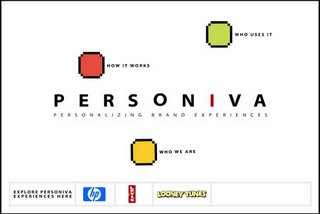
Here's a cool tool that brings something fresh to the world of viral video (for a good month or two, at least ;-) - Personiva. Personiva allows for the creation of branded content that can be personalized by the viewer, for the viewer. For example you might upload a photo of you, Personiva integrates it inside a specially-made commercial, and you get to watch a TV ad featuring you.
Check out HP's "Make computer personal again" and experience it yourself.

From the Personiva web site: "Personiva technology - recognizes faces, composites video, delivers dynamic imaging, creates interactive web interfaces, personalizes mobile messaging, drives e-commerce, measurable and ready-to-go."
While the experience is certainly new, its current application doesn't strike me as something that will last (the Levi's example on their site wasn't all that impressive), but I salute the idea. I do hope they find a way to push this a lot further.
|