Tuesday, November 06, 2007 by
David Claude, under
adkrispies,
opinion
Google recently announced that it would be jumping to mobiles, offering its Gmail application in a super-efficient, feature rich format for cellphones. Great idea? Yeah, great idea. And as of today, Google will now also be delving in cellphoneswith its new "Android" package.
Allow me to add an "It's just that"(tm)
I think Google has come up with functional and undoubtedly popular ideas up to now, and it wouldn't be adventurous to say that they started the wave responsible for generating what we now call Web 2.0. It's just that(tm) purely speaking on brand equity terms, my feeling is they need to take care of their image as well. Techwise, they're going a long way. But brandwise, I don't know what to think of Google right now. I just know that as a consumer, as The Shopper, I'm feeling less and less comfortable with them.
On the Microsoft vs. Apple scale (saying these two were extremes, and I guess they somewhat are), I wouldn't know where to place Google. Maybe in the middle. Maybe closer to Microsoft. Actually, quite close to Microsoft. Good for a business, bad for a brand. Popularizing the notion of dominating a category doesn't seem to be such a good thing these days. It is my perception that Shoppers are now actually looking for "micro-efficiency": very specialized things that do a lot. Small giants. And branding is in large part responsible for that.
ING Direct is my fave example of a small giant. It looks and sounds simple. It's clever. It doesn't give out the perception that it's trying to rule the world. It stays sympathetic, and on a people-level. It's communication and branding makes me believe that the banking services they are offering are simple to use, and are better (and different) than the competition's, on comparable grounds. Apple used to do that, now they're more product focused. Watch out Apple, watch out.
Will I use Google's Gmail mobile app? Maybe. But if a Flooz(tm) mail application ever comes out, with a big, bubbly, bold green icon and tells me something like Web Mail Has Never Been Smarter, I will most definitely jump on it. Because it gives me the perception that it's exclusive, simple, and specialized.
Conclusion? If you're going to take over the world with a great idea, do it and act big. But don't forget that being small will always be beautiful.
(Note: This must-read article is pretty long. Print it out and save it for lunch hour fun. Just my recommendation.)
I got the idea of this article after watching the above ads, by Serviceplan Münche in Germany. They're nicely executed, great art direction, and convey the simple message that Magic Scotch Tape is ultra effective. It'll probably get the creative team something nice at Cannes, or in anyone of 50+ different award shows in our industry.
It's just that I'm thinking that somewhere in Germany, a client for 3M has objectives to attain with his brand/product. His agency-of-record presents a funny, clever approach that says exactly what the product does: it holds things together. O-kay. Said approach is presented to consumer inside a magazine. Consumer goes "Heh. funny", and flips the page.
Total bill (my estimation of course) for this process : from $60,000 and up. And what did 3M get for that money? The same thing that watching a Bugs Bunny cartoon produces: entertainment. I took print as example, but the same thing happens on TV and on radio. A marketing action that doesn't encourage a consumer reaction in response is empty information.
Where could be the return on investment on this marketing action? Doesn't it seem cavernous to say that, nowadays, simple exposure to a Scotch Tape ad will make a consumer feel good about the brand, hence it will be its #1 thought when buying tape? Nope.Will being a "top-of-mind" brand offer a product tighter guarantee for extra sales?Nope-nope.Will Scotch Tape develop a long lasting, faithful relationship with the consumer by showing him/her funny, clever ads and promotions?Nope-nope-nope.All of this is starting to smell rank. Even the term "consumer" smells rank. "Consumer" sounds like a mindless pig buying away gobs of everything without consideration for anything.
When speaking about someone performing the action of looking for something to buy, we should roll back to the word "shopper". Nowadays, The Shopper is in charge, because the shopper really shops. The Shopper is informed. The Shopper compares. The Shopper talks to shoppers, who talk to Shoppers. The Shopper searches for advice. The Shopper is more product-oriented than brand oriented. The Shopper doesn't want a product that "delivers more", the Shopper wants to find the product that "compares better". The shopper wants to find a product that's just perfect for what he needs, that fits his/her lifestyle or brings novelty to it. And still, The Shopper needs some brand-name love, some flag value. And all this doesn't mean The Shopper buys only products and goods ; he/she can "buy" a cause, "buy" a service. There are so many these days, people shop for these too.
Advertising is a motor of commerce in our economy. There's no denying it. But it's just not done very well anymore, or for the right reasons. Lots of ad agencies are being paid too much for campaigns that don't work, and couldn't work anyway. Not because the message is weak, mind you. More because the media is outdated. Lots of clients are currently throwing millions out the window, because they're afraid to move out of the grasp of traditional media, hiding behind numbers and patterns. Lots of agencies and clients still don't know how to speak with a Shopper. The most recent womma.org newsletter, featured an article from the New York Times (clickable link) : Nike Backs Off Traditional Ads, Gets Closer to Consumers. Wow. And Nike's corporate vice president for global brand and category management doesn't have kind words for conservatism: “We’re not in the business of keeping the media companies alive,” Mr. Edwards says he tells many media executives. “We’re in the business of connecting with consumers.” Blunt, and brilliant. Read the whole article, it's an enlightening moment.
Advertising sometimes still treats people like its the Roman Empire: "Panem et Circenses" - Bread and Circuses (or games). But advertainment is not the way to go. It's not about creating 30 second, hair-raising TV moments anymore. It's not about creating clever print ads, or artsy layouts to satisfy the the eye and masturbate the mind.
Advertising nowadays is about creating conversation. Advertising nowadays is like this hot person you've been eyeing at a post-modern art exhibition, coming up to you suddenly, grabbing your hand and whispering in your ear "Let's blow this popstand. Let's jet and have fun out in the city. I'll present you to my friends". Advertising should be a constant motor for making people act, move, buy, see, talk, discover, play and react.
This doesn't mean that traditional media are dead. This means that they're not the main course anymore. They need to be used as gravy. Accompaniment for new, emerging ways to communicate, to generate conversation with The Shopper. All media need to form a chain that interacts, moving The Shopper around, encouraging him/her to take action - to "buy" into something, figuratively. Out with million-dollar TV-and-Billboard campaigns, in with budgets attributed to creative media that generate word-of-mouth, that generate concrete reaction, that let The Shopper be the vector of mass communication.
Is your advertising doing that right now? Great. It's not? Write me. I know a guy who can help you, hahah.
You know what Zune is. You have seen, heard or even felt it one way or another. Maybe you've even bought the little thing. Or consider buying it for this upcoming Xmas (or whatever you're celebrating at that time). And you probably hate Microsoft for coming up with something that looks and sounds probably more democratic than the iPod. And you're disappointed at Apple. Because has Apple made a big mistake with their iPod marketing: they have built a sect.
First, they have gathered everyone under their "Think Different" ideology, and had them buy their product because of that ideology and all the difference it brought in the world, and the world thought that it was a good thing. And it was.
Then, they have regrouped all their activities under the appealing iTunes, so that people would be better served under one functional, low-cost, low-piracy, high-selection system-of-purchase with, of course, limited usage licenses.What? Okay, maybe. But what if...? Oh never mind. It's Apple. They're good people.
But then, they started spreading their iPod categories into different sub-categories. Which now meant you had to choose between a) just listening to music, b) music and videos, c) the low-cost, less feature Shuffle option, and d) The iPod Nano. "Ooo. I wanna change. I wanna buy a new version of my iPod", you think. "But wait. Can't I have all these things in just one gizmo? Sony is doing it, and everybody else is! It looks...different...better", say you. "No!", say the Apple Sect leaders. That's not the same!We invented difference!Don't try to change things! Think Different (tm) !
But you're already starting to feel a bit queasy. There's that cool Sony PSP, that actually offers more features than the iPod, at a lower price. There are loads or cheaper mp3 players, that actually play mp3s too. Basically, all you wanted was music, right? But also, you have cell phones with mp3 players, and now, this strange Zune thing? You want out of the sect. You want to see what's out there. But getting out of the "Sect of Thinking Differently" is hard: sect members are definitive: "iPod is the coolest". If you don't own an iPod, you're not among the cool anymore. You're not using the Best Technology Available(Apple Sect Bible, chapter3, chant 2: iPod is the best technology available) Plus, it shows you're not part of those who "think differently".
"Be-like-us. Think differently. Be-like-us. Think differently", they all chant.
This hurts and shames you. And it makes your parting from the iPod sect the harder. Seeing they have gained back ground on your disappointment, the Apple Sect leaders try an even stronger solution. A solution that worked great back in 1998: color. They market an iPod with backlitcolor screens.
"Everybody will want one!", they say. They have this cool ad featuring people dancing with their color iPods, producing wild streams of color. "Color is freedom!", "Color is difference!", "everyone should go for color!" The "Sect of Thinking Differently" chants louder.
Old trick. You've heard it all before: looks arent' everything, it's what's inside that counts. You want a product that lets you discover what difference is. You want a product that doesn't constrain you, but allows you to break boundaries. And you don't want to be the property of a brand image anymore. You want your freedom.
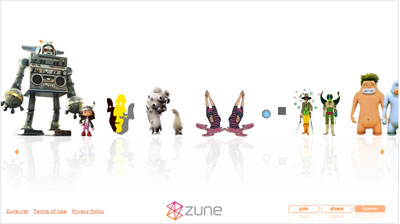
Zune has heard you. And to prove you they understand, they decided to democratize their marketing: they're not proposing a distinctive brand image or communication, but simply gave power to the people. Zune is a lot of things: it's not one thing. Zune is a tool of discovery.
With Zune Arts, they propel this fresh idea to the iPod universe, which stands befuddled.
Most people will say "Damn Microsoft! We think your product might actually be cool! But we hate you! WE WANT TO HATE YOU! Must...resist...Zune... ".
And so a new PC vs Mac epic has begun. But maybe this time, the "light" side is not who you think it is anymore. Unless you're thinking differently.
Here are a few of Zune's latest commercials. Enjoy.
Coolz0r will probably kill me for taking two of his post ideas onto AdKrispies, but I couldn't pass by this excellent ad for Time Magazine without the need for comment (see below):
This "cover" campaign has been a long runner advertising platform for Time, and it's not hard to find out why: two words and a picture are enough to raise questions. With such an ad, Time magazine doesn't define itself as a source of information on current events, it defines itself as THE source of information to find out the TRUTH. "Know WHY". There could be a thousand reasons why, all of which could be biased by many outstanding factors. There could be a thousand other realities claiming their right to be the TRUTH. But the core idea behind Time magazine's positioning is not to present you current events in a general, cover-everything-objectively-making-sure-we-inform-well, greyish manner. Time takes position behind one aspect of an event. And Time presents the TRUTH on that aspect. Bold and highly debatable approach? Yes. Powerful marketing? Yes. Both are what Time magazine was built upon: communicate powerful facts that generate powerful debate.
I'm a freelancer and free thinker in the field of marketing and communications, trying to continually expand the known universe in my little mind -- and yours.